Posts

Update: Current Virtuoso Violinists

Image
I'm not sure this list will ever be complete, but I will endeavor to continue to update when I find a violinist worthy to be called Virtuoso and performing on the world stage. Sarah Chang (pictured) is a Korean-American violinist, born in Philadelphia to Korean parents, she recorded her first album at 9 . While I find her playing a bit overly sentimental, the pieces I've heard her play are Dvorák and Sibelius which both tend to the sentimental category, so I don't think what I've seen is representative of her ability. She's certainly won plenty of awards. Here she is playing Dvorák's Violin Concerto . Anne Akiko Meyers (pictured) performed with the Los Angeles Philharmonic at age 11. (good grief, all these child prodigies). Her debut album was of the Samuel Barber and Max Bruch concertos, not a small feat. Here she is playing the first part of the Barber Violin Concerto . Realizing my list is dominated by women I thought I should include some men of ...

Hilary Hahn: An interview

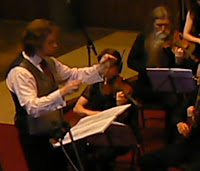
If you've not been to Hilary's website , she writes travel updates , which gives some insight into the performer. However, SFist has an interview which also gives another aspect to the performer's personality. You can also see her answer some questions on her YouTube channel .

Updates: Composers and Violinists

Image
Richard Termine for The New York Times In a couple of previous posts I mentioned conductor Lorin Maazel violinist Julia Fischer (albeit in separate posts). Vivien Schweitzer of the New York Times gives a review of their joint perfomance on Tuesday. The review speaks highly of Ms Fischer, "(she) plays with a remarkably sweet tone (evoking melting caramel perhaps) and long, refined phrases that have an operatic quality to them. She played the Mozart with expressive introspection in the Adagio and plenty of spirit in the Gypsy-tinged Rondo. Mozart did not write a cadenza for this concerto, so Ms. Fischer wrote her own, a highly effective piece featuring a dialogue between the upper and lower strings." Although the review was not skathing for Mr Maazel, it did say, "Mr. Maazel doesn’t seem to have been particularly influenced by historically informed Baroque styles...Mr. Maazel effectively conveyed the stately dignity of this work (despite a few unstately horn blun...

The Power of the Conductor

Image
Several months ago I had the great pleasure of conducting the premiere performance of my 'Symphony No 1, Figuratively Speaking.' The performance was well received even if the recording of it shows the performance to be lukewarm at best. You might think, as composer, that I'd know the work better than anyone else - and, as a new work, you're probably right. No matter how well I knew the piece, I was still amazed at how much I learned about the music during the process of rehearsing/conducting it, so the conductor obviously has a different vantage point of the music than the composer. Some of the players in the orchestra gave me glowing marks for my performance - and yet, I am still an amateur conductor and (IMHO) the performance showed it. The Edinburgh Symphony Orchestra has performed numerous other concerts, tackling some very difficult music. Not all the concerts are amazing, but certainly the orchestra, for being a subscription ensemble, can be proud of the perform...

Broadening Horizons in Music & Art

Image
There seems to be a theme to today's posts, broadening horizons. Reading the news today I came across an article by Michael Kimmelman of the New York Times about the conductor/pianist Daniel Barenboim. While the article is interesting in terms of illuminating who Mr Barenboim is, what Mr Barenboim says about modern musicians was far more poignant. “Rubinstein read Cervantes in Spanish, Dostoyevsky in Russian, Voltaire in French,” Mr. Barenboim said. “Music has become specialized today. There used to be a different notion of musical culture. I believe that Furtwängler genuinely felt — maybe he was naïve, but he felt that he personally could save German culture from the Nazis. He wrote about the introduction to Beethoven’s Fourth Symphony in relation to the Greek idea of chaos and catharsis. How many musicians think that way today? “A century ago the same people who knew Schoenberg’s music knew Kandinsky’s art. There was no separation. Rubinstein used to say that at the turn of...

Why does new music have to be non-musical?

Image
Ok, calling new music non-musical is not really fair, there are musical elements to the most atonal pieces by Webern, clustered conglomerations of Lutosławski, or the intense complexity of Ferneyhough. And (truly) I admire all of these composers... However, I do find it interesting that some composers and critics find music that doesn't push these kinds of boundries, that somehow 'returns' to tonal roots to be slushy neo-romantic and therefore tired and boring. Stravinsky, one of the greatest composers of the 20th Century explored numerous different styles and yet it was his neo-romanitic period which was contains his largest output. Messian explored a number of different styles as well, but felt his one serial piece was a failure (I agree) and eventually moved back to a more tonal style (although to call it neo-romantic is pushing the definition). Krzysztof Penderecki, who wrote "Threnody to the Victims of Hiroshima" (1960), a thoroughly modern piece of mu...

Blending Pop and Classical: a way forward

If Boris Johnson , the Mayor of London, considers pop music the dumbing down of our youth, then he really needs to take in more concerts like the one held at the MATA Festival . Founded in 1996 by Philip Glass, Eleonor Sandresky, and Lisa Bielawa, MATA presents pieces by young composers on a week-long festival, held each spring in New York City. The result is a blend of pop, classical, fusion, rock, electronica... et al. Allan Kozinn of the New York Times goes indepth in reviewing a recent performance by violist Nadia Sirota and the guitarist Andrew McKenna Lee. The festival is so successful this performance was actually an interval performance, one done outwith the festival's normal schedule and speaks of the popularity, the demand for this sort of concert. 'Mr Lee closed the program with “Sunrise From the Bottom of the Sea” (2005), an effects-heavy electric guitar work that paid homage to Jimi Hendrix, with passing nods to Jimmy Page and in a series of glittering trille...